(WITH PARTICULAR RELEVANCE TO THE PUNJAB)
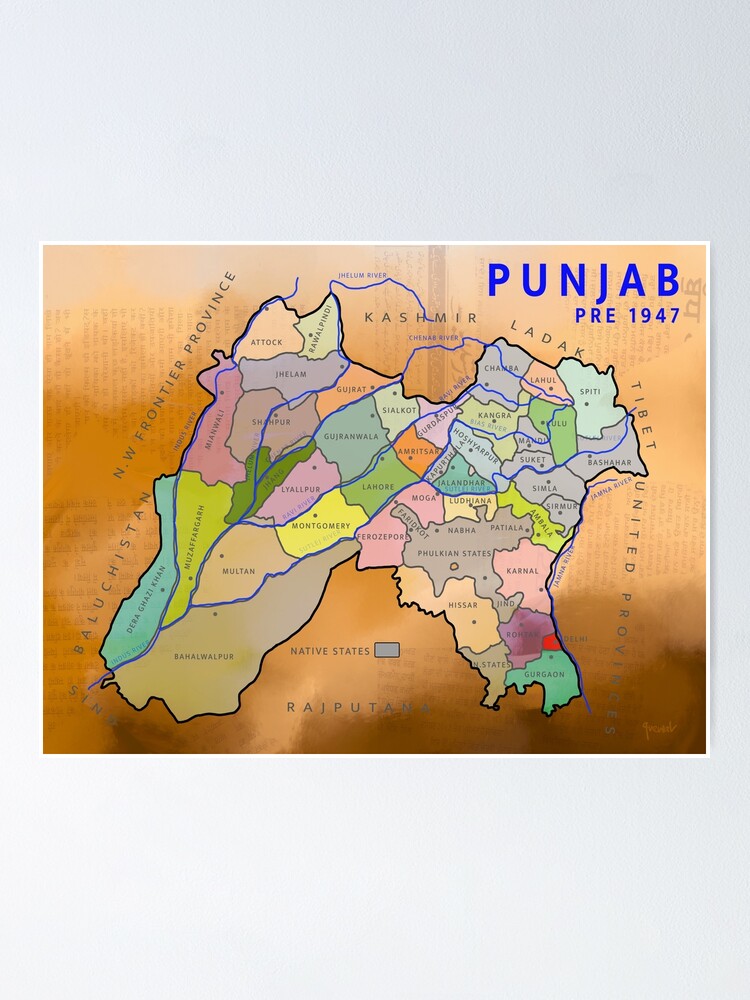
Source : www.redbubble.com
INTRODUCTION see map .
MOHENJODARO AND HARAPPA
THE ARYANS AND THE VEDIC AGE
The Aryans are said to have entered India through the Khyber pass, around 1500 BC. They intermingled with the local populace, and assimilated themselves into the social framework. They adopted the settled agricultural lifestyle of their predecessors, and established small agrarian communities across the region of Punjab. The next thousand year history of Punjab (or Arya-Varta, the land of Aryas, as Aryas called it) is dominated by the Aryans and their interactions with the natives of the Indus basin. Here is where the oldest books of human history called the Rig-Vedas are supposed to have been written. The Aryan tongue Sanskrit became a symbol of the Aryan domination of the area. The Aryans are believed to have brought with them the horse, developed the Sanskrit language and made significant inroads in to the religion of the times. All three factors were to play a fundamental role in the shaping of Indian culture. Cavalry warfare facilitated the rapid spread of Aryan culture across North India, and allowed the emergence of large empires. Their social framework was composed mainly of the following groups : the Brahmana (priests), Kshatriya (warriors), Vaishya (agriculturists) and Shudra (workers). It was, in the beginning, a division of occupations; as such it was open and flexible. Much later, caste status and the corresponding occupation came to depend on birth, and change from one caste or occupation to another became far more difficult.
RELIGIOUS AND SOCIAL DEVELOMPMENT
As time progressed the culture entered into an era of social and intellectual ferment and it was during this time (600BC) that Jainism and Buddhism -both promoting non-violence- evolved and had significant impact on North India. With land becoming property and the society being divided on the basis of occupations and castes, conflicts and disorders were bound to arise. Organized power to resolve these issues therefore emerged, gradually leading to formation of full-fledged state systems, including vast empires. Back to Contents
THE PERSIANS AND THE GREEKS India is found to be mentioned in the Bible twice in the book of Esther, “This is what happened during the time of Xerxes (486-485 BC), the Xerxes who ruled over 127 provinces stretching from India to Cush :” 127 …..provinces stretching from India to Cush. Esther 1:1 8:9. The kingdom of Xerxes was actually gained by his father Darius who was Darius the son of Cyrus (Ezra 4:5) king of Persia. Punjab lied at the outskirts of the great Persian empires and came under their control from time to time. During that time Punjab became the wealthiest Satrapy i.e., the province in the Persian kingdom. Greeks, the rival empire of the Persians, also had some knowledge of the area. In 327 BC, Alexander of Macedonia crossed into northwest India. He conquered a large part of the Indian territory before his generals, tired of war, forced him to return home. Alexander as with his other occupied areas established two cities in the area of Punjab, where he settled people from his multi-national armies which included a majority of Greeks and Macedonians. These cities along with the rule of the Indo-Greek thrived long after Alexander’s departure. The Greeks maintained the their rule on Punjab till 55 BC when the whole area was disrupted by the events happening in greater Euro-Asia.
INDIAN DYNASTIES
During the same time of Greek rule their was the emergence of great India dynasties. The first of these dynasties was the Mauryan (324-187 BC) whose foremost emperor was Ashoka the Great, who after converting to Budhism renounced warfare and reverted to non-violent means of control. After the Mauryan dynasty, other smaller dynasties came to pass including the Sungas (187-75), the Vikram era (58 BC), and the Kushan dynasty (64-225 AD). The Gupta Dynasty (320-475) AD was the next to have significant impact on India. This era is called the golden age of Indian history. It brought about a reforming of the Hindu religion as well as the emergence of the classical art forms and development of various aspects of Indian culture and civilization. The end of this era came around the 3rd Century with the subsequent invasions of the Huns of China. After the decline of the Gupta empire, North India broke into a number of separate Hindu kingdoms and was not really unified again until the coming of the Muslims.
ISLAMIC RULE
There are many Muslim rulers who invaded India. The first were at the frontiers of Gaandhaar (Afghanistan) around 700 AD. Significant invaders were Mohammed bin Qasim who conquered the Sind region in 712 and Mahmud of Ghazni who attacked Punjab 17 times during his reign (997 AD). Subsequent invasions eventually expanded rule all over India and in 1206 after Qutbudin Aibak took Varanasi and Delhi, he became the first of the Sultans of Delhi setting up the nucleus of the rule of Turkish and Afghan sultans, the Khiljis 1320, the Tughlaqs and the Lodis in 1479.
KABIR, NANAK AND THE BIRTH OF SIKHISM
It was during this time, of the ideas of two great saints, Kabir and Nanak emergerged in Punjab. Drawing on the devotional Hindu Bhakti and the mystical Islamic Sufi cults, the tolerance of Hinduism and the ideas of equality in Islam, they preached religions that advocated simple living and practical common sense. Kabir emphasized the oneness of the Divine in memorable couplets – “Hari is in the east, Allah in the west; look within your heart for there you will find both Karim and Ram.” Guru Nanak founded the Sikh religion .
THE MUGHALS The greatest Islamic empire was that of the Mughals, a Central Asian dynasty founded by Babur early in the 16th century. Babur was succeeded by his son Humayun and under the reign of Humayun’s son , Akbar the Great (1562-1605), Indo-Islamic culture attained a peak of tolerance, harmony and a spirit of inquiry. The nobles of his court belonged to both the Hindu and the Muslim faiths, and Akbar himself married a Hindu princess. Leaders of all the faiths were invited to his court at Fatehpur Sikri to debate religious issues at the specially built ‘Ibadat Khana’. Akbar tried to consolidate religious tolerance by founding the Din-e-Ilahi religion, an amalgam of the Hindu and the Muslim faiths. Mughal culture reached its zenith during the reign of Akbar’s grandson Shahjehan, a great builder and patron of the arts. Shahjehan moved his capital to Delhi and built the incomparable Taj Mahal at Agra. Aurangzeb, the last major Mughal, extended his empire over all but the southern tip of India, though he was constantly harried by Rajput and Maratha clans. In 1675 as Sikh resistance to Moghuls intensified, Guru Teg Bahdur, the 9th Sikh Guru was executed in Delhi by Aurangzeb. Back to Contents
THE MARTHAS & AFGHANS
By the early 1700’s the fall of the Mughal Empire came through the rise of leaders like Shivaji of Maratha who often plundered them. However the Maratha Empire never fully developed as they were defeated by Ahmad Shah Durrani from Afganisthan in 1761. Soon the Afghans maintained rule over much of the Punjab region. However, with the continual resistance of the Sikhs who established their rule over the region in 1764-5, and the entry of the British, the Afghans were not to succeed for long.
MAHARAJA RANJIT SINGH
The British East India Company starting operating in Calcutta in 1680. Meanwhile in Punjab there was much turmoil and struggle. It was a Sikh, Maharaja Ranjit Singh, known also as the Lion of Punjab, who would play a important role in stopping the Afghans. He united all the Sikhs, and built a mighty kingdom, which remained invincible for many years. Through his valor in military campaigns, the Sikhs were able to successfully push back the Afghans. As Ranjit Singh’s fame became known all over India, in 1799 he finally defeated the Afghans in Lahore, which had been their stronghold,. Ranjit Singh’s kingdom was from Kashmir in the north to Sind and Rajasthan in the south, from Khyber and Indus in the west into Delhi in the East. After his death in 1839, and after two Anglo-Sikh wars, Punjab was finally annexed to the British empire in 1849.
BRITISH INDIA
The British slowly but swiftly extended their rule over the entire subcontinent, either by direct annexation, or by exercising suzerainty over local rajas and nawabs. Unlike all former rulers, the British did not settle in India to form a new local empire. The English East India Company continued its commercial activities and India became ‘the Jewel in the Crown’ of the British empire, giving an enormous boost to the nascent Industrial Revolution by providing cheap raw materials, capital and a large captive market for British industry. The land was reorganized under the harsh Zamindari system to facilitate the collection of taxes to enrich British coffers. By 1857, the British empire in India had become the British empire of India as the rule of India was transferred from E.I. Co. to British Crown.. The means employed to achieve this were unrestrained and no scruple was allowed to interfere with the imperial ambition.
MUTINY OF 1857
A century of accumulated grievances erupted in the Indian mutiny of sepoys in the British army, in 1857. This was the signal for a spontaneous conflagration, in which the princely rulers, landed aristocracy, and peasantry rallied against the British around the person of the last Mughal emperor, Bahadur Shah. The uprising, however, was eventually brutally suppressed. By the end of 1859, the “emperor” had been deported to Burma where he died a lonely death, bringing to a formal end the era of Mughal rule in India. The Mutiny, even in its failure, produced many heroes and heroines of epic character such as Tantaya Tope, Jhansi Rani and Lakshmi Bai. Above all, it produced a sense of unity between the Hindus and the Muslims of India that was to be witnessed in later years. In 1885 the leadership of the freedom movement formed the Indian National Congress. Into the 20th century the binding psychological concept of National Unity was forged in the fire of the struggle against a common foreign oppressor. Most of the soldiers recruited from India during the World War I had come from Punjab, which, with only 7 percent of India’s population, had supplied over 50 percent of the combatant troops shipped abroad. It is thus hardly surprising that the flash-point of postwar violence that shook India in the spring of 1919 was in the Punjab. This served to rally millions of Indians.
MASSACRE IN AMRITSAR
Jallian Walla Bagh(Garden) was a park in Amritsar, Punjab, were people would go to on a pleasant day as it was a place for holding cattle fair and other festivities.. On one such Sunday afternoon, April 13,1919 many neighboring peasants had come to Amritsar to celebrate a Hindu festival, gathering in the Bagh. General R.E.H. Dyer marched 50 armed soldiers into the Jallian Wallah Bagh and ordered them to open fire on a protest meeting attended by some 10,000 unarmed men, women, and children without issuing a word of warning. Dyer kept his troops firing for about ten minutes, until they had shot 1650 rounds of ammunition into the terror-stricken crowd, which had no way of escaping the Bagh, since the soldiers spanned the only exit. About 400 civilians were killed and some 1200 wounded. They were left without medical attention by Dyer, who hastily removed his troops to the camp. A few days earlier Mohandas Karamchand Ghandi was on his was to a rally in Punjab. He had just called upon his country to take sacred vows to disobey the Rowlatt Acts, launching a nationwide movement for the repeal of those repressive measures. Ghandi’s appeal received the strongest popular response in the Punjab, where the nationalist leaders Kichloo and Satyapal addressed mass protest rallies from the provincial capital of Lahore to Amritsar, sacred capital of the Sikhs. The massacre had taken place at one such rally. The massacre had a nation wide reaction. A year later, Mahatma Ghandi launched his first Indian satyagraha (“clinging to the truth”) campaign, India’s response to the massacre in Jallian Wallah Bagh which turned millions of patient and moderate Indians from loyal supporters of the British raj into national revolutionaries who would never again trust to British “fair play” or cooperate with a government capable of defending such action.
FREE INDIA
Under the leadership of Gandhi, the Congress launched a series of mass movements – the Non Cooperation Movement of 1920-1922 and the Civil Disobedience Movement in 1930. In August 1942, the Quit India movement was launched. “I want freedom immediately, this very night before dawn if it can be had.’.. we shall free India or die in the attempt, we shall not live to see the perpetuation of our slavery”, declared the Mahatma, as the British resorted to brutal repression against non-violent satyagrahis. It became evident that the British could not maintain the empire, and so they initiated a number of constitutional moves to effect the transfer of power to the sovereign State of India. India achieved independence on August 15,1947. Giving voice to the sentiments of the nation, the country’s first prime minister, Pandit Jawaharlal Nehru said, “Long years ago we made a tryst with destiny, and now the time comes when we will redeem our pledge, not wholly or in full measure, but very substantially. At the stroke of the midnight hour, when the world sleeps, India will awake to life and freedom. A moment comes, which comes but rarely in history, when we step out from the old to the new, when an age ends and when the soul of a nation, long suppressed, finds utterance …. We end today a period of ill fortune, and India discovers herself again.”
 Home Page
Leave a comment